Views: 0 Author: Site Editor Publish Time: 2026-05-22 Origin: Site
A bridal veil is not just an accessory. It is an architectural element. It defines the silhouette and final aesthetic of the wedding look. It frames the face beautifully. It also extends the body's natural lines directly into the venue space.
Choosing the wrong veil length or fabric creates real problems. You might truncate the body's lines entirely. You could obscure costly dress details. You might even create logistical nightmares at the venue. Brides often realize too late how wind, rough terrain, or heavy fabrics ruin their carefully planned aesthetic.
This guide bypasses generic style advice entirely. We provide precise measurements and material evaluation frameworks. We also share strict structural rules for pairing veils with dress silhouettes. You will learn exactly how to balance volume, manage tricky terrain, and secure the best quality materials.
**Precision Matters:** Standard lengths vary by manufacturer; always measure veil requirements in exact inches/centimeters rather than relying on industry names.
**The Complement/Contrast Rule:** Highly embellished dresses require understated, single-tier veils, while minimalist gowns benefit from the volume and texture of Cathedral lengths.
**Architectural Alignment:** The veil's hemline must never visually cut across the widest part of the dress or obscure key back details (e.g., illusion backs or corsetry).
**Material Sourcing:** Evaluating the fabric grade (e.g., Italian tulle vs. standard netting) from a reputable bridal veil manufacturer dictates both drape and photographic quality.
Precision is crucial when styling your wedding look. Ambiguous names like "long" or "short" cause styling disasters. You must evaluate technical dimensions. You also need to understand how each specific Bridal Veil Length alters your overall proportions.
This style ends exactly at the bride’s outstretched fingertips. It represents the most universally adaptable option available today.
Fingertip veils are perfectly engineered for mermaid or trumpet gowns. The fabric ends exactly where the skirt begins to flare. This creates flawless visual continuity. It guides the eye down the body naturally.
In implementation reality, this length is excellent for ease of movement. You require zero train management. You can walk, turn, and greet guests without snagging the edges.
Chapel veils sweep the floor elegantly. They typically extend slightly past the gown's natural hem.
They are ideal for A-line and soft flowing dresses. A Chapel veil creates a subtle "puddle" effect on the floor. This provides about 2.5 feet of trailing fabric. You achieve highly romantic photography without carrying excessive weight on your head.
However, implementation reality demands caution. This style requires a smooth aisle surface. It is highly prone to snagging on rustic outdoor terrain or uneven stone steps.
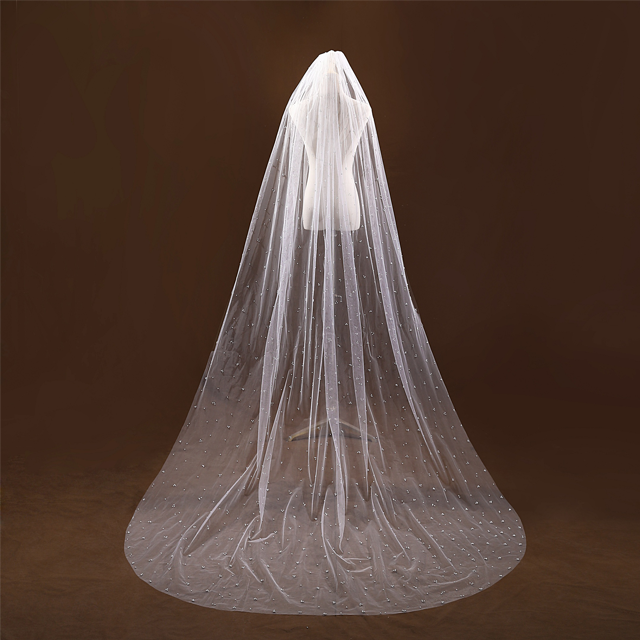
This represents the traditional formal length. It extends several feet beyond the dress train itself.
Cathedral veils deliver high-drama red carpet aesthetics. They suit grand indoor venues perfectly. They pair exceptionally well with simple, unembellished sheath dresses. This pairing creates a stark structural contrast.
The implementation reality is demanding. You need active management by the bridal party. Bridesmaids must arrange the fabric during the ceremony and portraits. Heavy fabric creates a high risk of pulling sharply on the comb.
Beyond the classic trailing styles, shorter alternatives offer distinct functional benefits. They serve highly specific dress silhouettes.
Birdcage (4"-9"): Offers face-framing, retro styling. It causes zero dress interference.
Shoulder/Elbow (20"-25"): Ideal for tea-length dresses. It perfectly complements vintage 1950s silhouettes.
Waltz/Ballet (60"): Ends safely between the knee and ankle. It is optimal for brides prioritizing dancing. You do not sacrifice traditional drape.
Summary Chart: Bridal Veil Dimensions | |||
Style Name | Length (Inches) | Length (Centimeters) | Ideal Dress Match |
|---|---|---|---|
Birdcage | 4" - 9" | 10cm - 23cm | Retro, High-Neck, Minimalist |
Fingertip | 38" - 42" | 96cm - 106cm | Mermaid, Trumpet |
Waltz / Ballet | 60" | 152cm | Ankle-Length, Reception Dresses |
Chapel | 90" - 96" | 228cm - 244cm | A-Line, Fit-and-Flare |
Cathedral | 108" - 120" | 274cm - 305cm | Sheath, Grand Ballgowns |
You must apply strict visual-merchandising logic here. Pairing veils and gowns requires architectural planning. You cannot rely on mere guesswork.
The hemline must end either well above the dress's focal point or flow entirely past it. You should never let a veil hem intersect a dramatic backline. It must never cut across a heavily appliquéd waist. Doing so breaks the body in half visually. It creates a truncated, messy look.
Visual weight dictates how harmonious your final outfit appears. You must choose between contrasting your gown or complementing it.
Minimalist Gowns: You should leverage volumetric, multi-tier, or intricately laced veils. This adds much-needed dimension. We call this the Contrast approach.
Heavy Lace/Ballgowns: You must utilize a "barely-there," sheer drop veil. Look for clean, unadorned edges. This prevents visual clutter. We call this the Complement approach.
Many modern gowns feature complex rear architecture. You might have a low-cut back, illusion lace, or a statement bow. Do not hide these features under dense gathered tulle. Utilize either a sheer, ungathered fingertip veil or a sweeping Cathedral veil. These act as transparent windows. They never act as solid barriers.
Environmental realities routinely cause buyer's remorse. You must account for the physical constraints of your wedding location before purchasing accessories.
Wind factors easily disrupt lightweight long fabrics. A sudden gust turns your accessory into a parachute. Beach or cliffside venues necessitate heavier borders. You might use a mantilla lace edge to weigh the tulle down. Alternatively, choose shorter lengths like Fingertip or Waltz. These prevent the fabric from acting as a sail.
Different floors grip fabrics differently. Traditional net tulle catches easily on rough wood floors. It snags on outdoor twigs instantly. A Cathedral length dragged on an uneven surface generates friction. This friction constantly pulls backward at the bride's hairstyle. Marble or polished concrete aisles handle long trailing fabrics beautifully.
Brides must evaluate their timeline. Will you wear this piece strictly for the ceremony and portraits? Or is it meant to be worn through the reception? Long trailing styles typically require removal post-ceremony. You need full mobility for dining and dancing. Keep this in mind when budgeting for secondary hair accessories.
Procurement standards matter deeply. You need to evaluate quality strictly to avoid cheap, stiff imitations. Sourcing from a reputable Bridal Veil manufacturer guarantees superior construction and drape.
Not all netting behaves the same way under a camera lens. The raw material defines the final aesthetic.
Traditional Tulle: This is highly cost-effective. It holds its structure and volume perfectly. It remains highly durable throughout a long event.
Italian Tulle: This features finer micro-hexagons. It offers a much softer touch. It creates a fluid, cloud-like drape without any stiff puffiness.
Silk-Style/English Net: This material is ultra-fluid. It features a heavy drape with zero puffiness. However, it remains highly delicate and prone to tearing.
Fabric Comparison Matrix | |||
Fabric Type | Volume/Structure | Softness Level | Durability |
|---|---|---|---|
Traditional Tulle | High Volume | Moderate | Excellent |
Italian Tulle | Moderate Volume | Very Soft | Good |
Silk-Style Net | Zero Volume (Flat Drape) | Ultra Soft | Fragile |
Attachment methods reveal the true quality of the item. High-quality manufacturers hand-sew the tulle directly to a metal comb. They never glue the fabric to cheap plastic. Hand-sewing allows the fabric to sit flush against the head. It prevents a bulky, unnatural ridge near your hairline.
Color naming conventions deceive many buyers. "Ivory" varies drastically between a dress designer and an accessory maker. Always mandate physical fabric swatches before commissioning custom work. You must ensure optical alignment under natural light. A mismatched white tone looks painfully obvious in professional photography.
Measurement errors destroy proportional harmony. You need clear, actionable shortlisting and measurement steps. This ensures a flawless final look when ordering your Bridal Veil.
You must follow one strict rule for trailing styles. For floor-length, Chapel, or Cathedral pieces, the fabric must extend at least 10 to 12 inches past the absolute end of the dress's train. This creates an intentional, cascading visual tier.
Do not guess these numbers. Follow this precise execution strategy:
Put on your actual ceremony shoes and your dress.
Have a tailor or consultant locate the exact point on your head where the comb will sit.
Measure straight down your back, trailing out onto the floor.
Extend the tape measure 10 to 12 inches past the dress's longest point. Record this exact number.
You must be aware of manufacturer sizing jargon. Ensure you completely understand sizing quotes. Ask if a quoted "120-inch veil" means a single 120-inch layer. Sometimes, factories mean a 90-inch base plus a 30-inch blusher stacked together. This misunderstanding leaves brides with a piece far shorter than anticipated.
The optimal length is a precise mathematical equation. You must balance the gown's architecture, the venue's physical constraints, and your desired visual drama. Form and function must coexist perfectly on your wedding day.
Lock in your dress and venue first. Order physical fabric swatches from your shortlisted makers to confirm exact color matching. Always measure your dimensions while wearing your actual ceremony shoes. Take control of these technical details early to ensure a flawless, stress-free aesthetic.
A: Yes. A long veil (Chapel or Cathedral) should always extend 10–12 inches beyond the dress train. This creates a cohesive, tiered visual flow. Stopping short makes the look feel accidental or awkwardly truncated.
A: The blusher is the top tier of a two-tier veil. It is designed to be worn over the face during the ceremony. When flipped back, it adds beautiful volume to the crown of the head.
A: Yes. A Fingertip veil pairs beautifully with long trains. It allows the dress's intricate back and lower train details to remain the primary focal point without any visual interference.
A: Never rely on the name of the color (e.g., "Diamond White"). You must compare physical tulle swatches directly against your dress fabric. Always check them together in both natural daylight and venue lighting.